Thursday, December 29, 2016

TORTURED LOVE

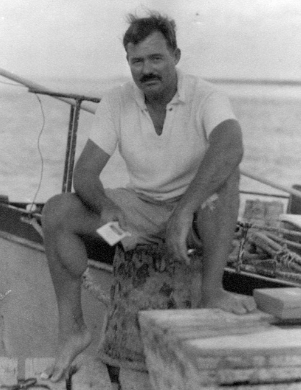
Ernest Hemingway at work

Dearest Hem,

Your letter to Pauline, dated November 1926 is a sad testament to a tortured soul when it comes to love, and attachment, and obsession. There is so much of your passion reflected in this letter but reflected in such a way that the figure in the glass is a distorted, wounded, self debasing vision of the "man's man" of a writer that you give the world. My heart breaks for you.

What I see is that little boy Ernest, trying to be what others want, or need, or expect, and losing himself in the process. Being the caped hero can be exhausting, and being the caped hero who portrays wearing a cape as something for sissies is debilitating. This process has you intentionally cutting yourself off at the knees to prove you're a man's man and to debunk any and all stories that you live in the shadow of your mother. When it comes to women your relationship with your mother has forever tainted whatever comes after.

You are desperately down when you write Pauline, "Now I can look back on the days when I had just strait lonesomeness and waiting for you - but knowing that everything was all right and that it was just waiting - and they seem unbelievably happy. Because now you have given yourself and your heart as a hostage to your mother too and the whole thing seems so absolutely hopeless." Dear Hem, you have found a kindred soul in Pauline as you both are held hostage by your mothers. It's no wonder that the conditions of the separation have the capacity to reach right down and rip your heart out.

I am amazed at your level of insight, my friend, when you write, "I know you did the extra three months because you thought that was what Hadley wanted - and also because at the time you were in such a state that sacrificed seemed like the thing to do. And of course al that Hadley wanted was to delay the divorce - anything to delay the divorce - she didn't want to just smash us both up - she won't admit it but she knows we're the same person - sometimes she has admitted it - but instead of giving her the delay that is practically the only thing left in the world that she wants we railroad her toward divorce and smash ourselves both up at the same time. That makes nice thinking too."

The most telling thing that you share in this heart wrenching letter is when you speak about killing yourself because of the apparent hopeless nature of the situation. You point to the fact that you had made a promise to Pauline not to act rashly until she had returned from her exile, but, in the light of her personal emotional deterioration, as well as yours, you asked if this didn't excuse you from your promise. You write, "But now it is getting all out of control again and you have broken your promises and I should think that would let me out. Only nothing ever lets you out. But I'm not a saint, nor built like one, and I'd rather die now while there is still something left of the world than to go on and have every part of it flattened out and destroyed and made hollow before I die."

At the end of your letter, like the soliloquy before the hero plunges the dagger into his heart, you write, "And all I want is you Pfife and oh dear god I want you so. And I'm ashamed of this letter and I hate it. But I had to get this poison out and I've just been stewed in it and not hearing and all the mail boats that get in with nothing on them and then that horrible awful letter from your mother yesterday in which you were getting your just punishment." And there it was, the affirmation that your own life echoed, that the punishment of a mother is the most damning, the most damaging, the most lasting - there is nothing more lasting than a mother's "love."

There is no winner to be found in this version of Sartre's Huis Clos that is your life at this point. My heart goes out to you, to Pauline, and to Hadley and Bumby who's lives will be forever changed by these events that have been set in motion.  Sometimes there's no benefit to identifying a winner. Sometimes it's simply about picking up the pieces after the storm and trying to piece life back together again into something that allows you to move on.

Hem, I trust in your capacity to construct a story line and I trust in your ability to create something of the pieces that lie at your feet.

Wishing you better days,

Betsy

Thursday, December 15, 2016

SUCCESS SHADOWED BY CHANGE

Ernest Hemingway and Pauline Pfeiffer

Dear Ernest,

It was so good to read your letters to your friends, in the early part of 1926. It seems as if everything is coming together. After all of the struggle, and rejection, and doubt (particularly that of your parents) around whether you were really made of the stuff it was going to take to be a successful writer. Here, finally, it's starting to unfold.

You write to William Smith and Harold Loeb, "I got loose from Liveright on account him turning down the satire. Scribners say they will back me solidly and loyally no matter how the books turn out financially. So now I don't have to worry. Only to work. will try and write some swell ones. I'm not going to think any more about what is to happen to the stuff. Just work."

In addition, my dearest Hem, you have found a true place of creative retreat in Schruns, Austria. Here, in the company of fast friends the likes of John dos Passos and Expats John and Sara Murphy you exercised your passion for the outdoors and devoted yourself to editing The Sun Also Rises.

Your relationship with Scribners would prove to be an over twenty-year partnership that was bound by your personal friendship with Maxwell Perkins, your editor at Scribners. It is interesting, dear Hem, that just as you were forging this lasting relationship with Scribners and Perkins, you were, at the same time falling for yours and Hadley's dear friend, Pauline Pfeiffer. Latter, in your biography, A Movable Feast, you wrote, "I should have caught the first train from Gare de l'Est... to Austria. But the girl I was in love with was in Paris then, and I did not take the first train, or the second, or the third. When I saw my wife again... I wished I had died before I ever loved anyone but her."

What I find interesting is that you continued to muddle along, going between the two women in your life and purposefully avoiding doing anything about it, particularly when it came to your family. You actually took extra measures to keep the whole affair under wraps and secretive. 

Hem, you had to have known it would happen sometime. Hadley discovered the affair in early May when all of you, including Pauline's sister, Virginia, were on a trip through the Loire Valley, in France. However, the rest of the world was still in the dark.

The avoidance was certainly made easier by your preoccupation with putting the finishing touches on The Sun Also Rises, writing back and forth with the likes of Ezra Pound, and F. Scott Fitzgerald and traveling back to Spain for the bull fighting season. By July and August of 1926 you still hadn't resolved anything and you were still carrying on the charade of Pauline being "simply a family friend" even though there were now those in your inner circle who definitely knew better. 

Hadley, in her infinite wisdom (or mutual efforts at avoidance) invited you and Pauline to come and stay with her and Bumby, at F. Scott Fitzgerald's place in the French Riviera where she and Bumby were recuperating from whooping cough. You even wrote about the experience in your novel The Garden of Eden. But, your marriage, eventually did fall apart, didn't it?

You and Pauline returned to Pamplona, Spain for the bull fights and Hadley and Bumby returned to Paris to set up separate residences. Dear Hem, even as you continued to try to live your life on your terms and to write on your terms, the world, people, and events would continue to press back, censoring, editing, shaping and ultimately, from your perspective, constricting that freedom you were so driven to express. You write to your editor, Maxwell Perkins, in August of 1926, "I've tried to reduce profanity but I reduced so much profanity when writing the book that I'm afraid not much could come out. Perhaps we will have to consider it simply as a profane book and hope that the next book will be less profane - or perhaps more sacred."

It was all bound to come to a head, Ernest, and it did when Hadley insisted that you and Pauline live apart for six months, with no contact, and if at the end of that time you still felt you were in love she would give you her blessings and grant the divorce. So, September of 1926 saw Pauline sailing for the States to spend the six months with her parents, and you facing a that same extended time without her.

What will come of all of this only time will tell. 

Hoping it all works out,
Betsy


Tuesday, November 15, 2016

EMERGING INTO THE LIGHT

Hadley, Bumby, and Ernest

Dear Ernest,

So sorry to hear about the rejection of your book Torrents of Spring by Liveright. I do have to ask, after reading it, if you didn't believe that the possibility existed for Liveright to reject the story? The book is clearly a parody of Sherwood Anderson's work, Dark Laughter. 

In your draft of your letter to Horace Liveright, dated January 19, 1926, you write,"I did not submit the Torrents of Spring to you in the hope that you would turn it down. I consider it a good book and John Dos Passos, Louis Broomfield and Scott Fitzgerald, who are people of different tastes are enthusiastic about it. Your turning it down was your own affair." You further share with Liveright your belief that this rejection constitutes a breach of contract regarding the agreement that you had with him, "As Torrents of Spring is my second completed book and as I submitted it to you and as you did not exercise your option to publish it; according to my contract with you your option on my third book then lapses. This is quite clear and open and shut."

Wow! Bold move, my friend! I know you have not been comfortable in the relationship you have had with Boni & Liveright for some time. It is apparent that you feel that their strict censorship (from your perspective), is no longer tolerable. As well, their sense of priority when it comes to their authors, and the possibility that they are deferring your work to that of their primary author (Sherwood Anderson) has to rub you the wrong way. 

I have to believe, Hem, that you have a heightened sensitivity to being forced to live in another's shadow. You have, in your own life, made the bold move to step out of the shadow cast by your family, and it follows that you would not be very tolerant of any relationship that recreated those conditions and feelings.

Timing is everything, right? You are certainly in good company and, I'm sure, under advisement from those close to you, in your literary circles, that finding the right publisher is everything. 

You wrote to Liveright of these influences, "...I have already received offers for the Torrents of Spring and The Sun Also Rises, which I am still working on, from several publishers. I have not approached these publishers. They have heard of the books from friends who have seen manuscripts and in whose judgement they place some confidence."

It seems, Hem, that you've formulated a plan forward and have the support of friends and colleagues who have the ears of top publishers and publications. I look forward to seeing how and where you settle as you continue to build momentum in your writing and in your readership. 

I'm looking forward to learning more about how you're putting it all together. This is a very fluid time in your life with lots of possibilities, and lots of decisions and choices. It's good that you have Hadley and Bumby to help anchor you during this time. When I think of you and Hadley, I am reminded of a poem by John Donne, 

If they be two, they are two so
   As stiff twin compasses are two;
Thy soul, the fix'd foot, makes no show
   To move, but doth, if the' other do.

And though it in the centre sit,
   Yet when the other far doth roam,
It leans, and hearkens after it,
   And grows erect, as that comes home.

Such wilt thou be to me, who must
   Like th' other foot, obliquely run;
Thy firmness makes my circle just,

   And makes me end, where I begun.

It seems to be written in your stars, dear Hem, that you are destined to "obliquely run" and having that home port to return to can feel like both a blessing and a curse. I know, I've felt that way many times.

I do so love your letters!

With Warmest Regards,
Betsy

Friday, November 11, 2016

COMERADESHIP

Ernest and Bumby-Photo by Man Ray


Dearest Hem,

It is obvious that you are in the midst of a creative maelstrom that promises to sweep you up in it and take you to places yet unimagined!  In your letter to your fellow writer and friend, Ernest Walsh, dated January 2, 1926 you write, "There is comradeship today and I have it with Don Stewart and Dos Passos and a guy named Chink and a guy named Howy Jenkins and several other guys and would have it with you if we could bum around together."


You have such strong emotions around this idea of "comradeship." It is almost as if those who you hold dear in this exclusive circle of friendship are like your family to you. Your expectations of their commitment and loyalty are such that they can be hard to live up to.


In your letter you speak of your disappointment with poet and writer Robert McAlmon. This is the same man who published your first book, Three Stories and Ten Poems in 1923, and who financed and accompanied you on your first trip to Spain. In a sense, McAlmon was one of those key people who nurtured and supported you when, perhaps, others weren't yet on-board.


In your letter to Walsh you share that, "The last day I was in Paris I went around looking for him (McAlmon) intending, when I found him, to beat him up..." In your letter to F. Scott Fitzgerald, dated December 24, 1925 you called McAlmon, "a son of a bitch with a mind like an ingrowing toe nail."


Ernest, you are a difficult person, at times, and that's not to say that those who care about you aren't accepting of that difficulty. That being said, there may be times when those who care about you simply aren't able to stand in the gale force winds that you're life sometimes whips up.


Walsh put it best in his poem entitled "Ernest Hemingway" that was published in the second number of This Quarter (Autumn-Winter 1925-1926):


Papa soldier pugilist bullfighter
Writer gourmet lionhead aesthete
He's a big guy from near Chicago
Where they make the shoes bigger and
It's a good thing that because he aint
Got french feet Napoleon and him
Wouldn't have said much together
he'd have pulled Buonaparte's nose
And absolutely ruined french history

Dear Hem, your passion for what you do and how you love the written word permeates your letter to Ernest Walsh and Ethel Moorhead dated January 15, 1926. You write, "This Quarter came this morning. IT IS SPLENDID... as it should be - and mechanically a hell of a fine performance. As for what is in it: it is the first exciting magazine I have read since I was 13 and used to wait for the baseball magazine to come out. That's God's truth."

I am reminded of one of my favorite quotes, "If I was a dog I'd roll in it."

I'm looking forward to reading more of your letters and coming to understand "life according to Hemingway". 

With Warmest Regards,
Betsy

Sunday, October 23, 2016

MAKING A PLACE FOR YOURSELF

Ernest Hemingway and poet and writer Robert McAlmon
at the bullfights in Madrid

Dear Ernest,

1925 was certainly an action packed year for you! 

The month of April saw you pitching in to help out with Ernest Walsh's quarterly publication, The Quarter, to help get it out the door and published. You wrote Ezra Pound about it, "...and the continued activity of myself working like a son of a bitch to get Walshs magazine into the and off the press. Walsh put it my hands as a friend to help him outa his mechanical difficulties. Two hundred and sixty four pages and fifty reproductions can present considerable difficults when being printed by printer hitherto only done job printing."

At the same time you were wrestling with Walsh's publication and an inexperienced printer, you were struggling with your own issues. Having sent In Our Time off to your publishers, Boni and Liveright, you then found yourself going back and forth with the publisher over the stories that comprised In Our Time. At the same time you were being courted by Maxwell Perkins, from Charles Scribner's Sons, Publishers.

Throughout the exchange of letters between yourself and Boni Liveright I detect that the restraints, that Liveright was working to put on your work in order to make it "publishable" in their eyes, were a point of some irritation for you - sometimes more, sometimes less. Throughout your correspondence with Liveright it never feels like you are able to be truly comfortable with their approach to you or your material.

Your letter to writer, John Dos Passos, dated April 22, 1925 reflects the beginnings of a long and colorful friendship as well as your discomfort with your publishers, "Jesus I wish you were over here so we could get drunk like I am now and have been so often lately... You're a good guy, Dos and I wish to hell you were here... I sent back the signed agreement to Liveright on the 1st of April about and they were to send me the $200. but it hasnt come yet. Nor any word from them. A Mrs. George Kauffman is here and she claims they want to cut it all cut the Indian Camp story. Cut the In our Time chapters. Jesus I feel all shot to hell about it. Of course they cant do it because the stuff is so tight and hard and everything hangs on everything else and it would all just be shot up shit creek. There's nothing to bother anybody. Not a dam thing."

You close your letter to Dos Possos with, "Dont let them cut it. Tell Liveright not to be a damned fool.

As colorful as your letters are to your literary friends, your letters back to your parents are as comparatively conservative and dry, focusing on fishing, an overview of your writing accomplishments, and their grandson, Brumby. 

You write to your father, "I do hope you will get some fishing. We plan to go to Spain June 25 for a mo or 6 weeks. Get ten days of fishing in the North. I have a commission to write a book on bull fighting for a German publisher and will follow the corridas from Pamplona July 7-13 down to Sragossa, Madrid and Valencia. I will be in the ring some of the time studying the business from close to but if you hear any reports of my being hurt discount them and don't worry as I will take good care of myself."

Compare what you wrote above with what you wrote to Gertrude Stein and Alice B. Toklas, while on your trip to Spain, on July 16, 1925, "We have had a fine time and no bad hot weather and seen Belmonte cogida-ed and he is not so bad, and had a bull dedicated to us and Hadley got the ear given to her and wrapped it up in a handkerchief which, thank God was Don Stewarts. I tell her she ought to throw it away or cut it up into pieces and send them in letters to her friends in St. Louis but she wont let it go and it is doing very nicely."

Dear Hem, as you begin your long love affair with the running with the bulls, so too do you initiate relationships with various literary and creative figures that will influence you in many, many ways. You count, among your friends, associates, and confidants the likes of Sherwood Anderson, American novelist and short story writer; George Antheil, American avant-garde composer; Sylvia Beach, owner of the Left Bank Paris bookstore Shakespeare and Company; John Dos Passos, American writer and author; F. Scott Fitzgerald, American novelist and short story writer; Zelda Fitzgerald, American writer and painter; Lewis Galantiere, journalist, translator of French literature and playwright; Christian Gauss, professor of Modern Languages at Princeton University; Alyse Gregor, novelist and managing editor of the Dial; Jane Heap, co-editor of the Little Review; Eugene Jolas, journalist, poet, translator and editor; Harold Albert Loeb, American writer and editor; Archibald MacLeish, American poet and writer; Robert Menzies McAlmon, American poet, fiction writer, and publisher; Edith Moorhead, painter and influential Scottish suffragist; and the list goes on, and on, and on.

It's impressive the level of immersion you've achieved in your art, in the literary world at large and in Paris in particular. In my lifetime I can only name a handful of people who have achieved the notoriety or fame that those in your general circle of influence have achieved, and you at the "ripe old age" of 26. You, my dear friend, are in for the ride of your life. 

I'm looking forward to seeing what the future holds for you. I just hope you can survive the meteoric effects of the life of immersion you've chosen. 

Wishing you all the best,
Warmest Regards,
Betsy


Monday, October 17, 2016

GROWING AS A WRITER

"Nobody lives life all the way up except bull fighters."
Ernest Hemingway

Dearest Hem,

Your love affair with Spain and Bull Fighting has begun! You write, "Spain is damn good in hot weather! Went down there about two months ago to study bull fighting and lived at a bull fighter's pension in the calle San Jeronimo in Madrid...the big Feria at Pamplona - five days of bull fighting dancing all day and all night - wonderful music - drums, reed pipes, fifes - faces of Valasqueze's drinkers, Goya and Greco faces, all the men in blue shirts and red handkerchiefs - circling, lifting, floating, dance. We the only foreigners at the damn fair."

You write of your passion for bull fighting, "It isn't just brutal, like they always told us. It's a great tragedy - and the most beautiful thing I've ever seen and takes more guts and skill and guts again than anything possible could. It's like having a ringside seat at the war with nothing going to happen to you."

That theme Hem, that theme of heart wrenching tragedy marked by brutality, courage and beauty, will surface multiple times in your letters and around various life events as you continue to weave the story of your life. I can't help but think that the combination of visiting your old WW1 sites with Hadley, and rehashing the events around those sites along with the raw and visceral pageantry of bull fighting triggered in you a pattern of remembrance that embraced the beauty of the tragedy of both war and bull fighting.

The all consuming celebration of the running of the bulls and the bull fights a Pampalona had to be similar to the drive to live every moment to its fullest, to grab life by the horns and never let go in the face of war and death. How many times in your life did you escape death and wonder, "Why me?" 

1923 saw you continuing to work for the Toronto Star as a reporter as well as writing short stories for publication. The relationships you build with the likes of Ezra Pound and Gertrude Stein will provide the literary base you need to continue to hone your craft. 1923 was also a year where you had to adjust to the challenge of fatherhood, as John Hadley Nicanor Hemingway came into the world in October. You would travel back to North America for the birth, and take up residence in Toronto.

The birth of your son and your resignation from the Toronto Star in 1924 marked another turning point in your focus and career. By January, 1924 you will be back in Paris with Hadley and Bumby (your son) and back at the task of writing and working to get published.

During this time period, as you struggle to get published, as you write short stories and grab life by the horns taking it all in and experiencing its many faces, you continue to dial in your perspective and view and develop a language that will become easily identifiable with Hemingway. Your growing circle of literary friends and supporters are essential to you in maintaining perspective and momentum as you ride out the disappointment of rejection letters and evolve your capacity for self criticism and improvement.

The years 1923 to 1925 are packed with life experiences and learnings around writing, publishing, networking and maintaining balance and sanity through the ups and downs. Hadley proves to be an anchor during this time and the freedom you've been able to experience through the influence of her trust fund has allowed you to indulge in full immersion in ways that would not have been possible otherwise.

My heart breaks for you, dear Hem, as you continue to suffer under the disapproval and rejection of your parents regarding your writing. In your letter to your father, dated March 20, 1925, you share, "The reason I have not sent you any of my work is because you or Mother sent back the In Our Time Books. That looked as though you did not want to see any. You see I'm trying in all my stories to get the feeling of the actual life across - not just depict life - or criticize it - but to actually make it alive."

Your sister Marcelline would recall that your parents had been "shocked and horrified" by the book that they returned to the publishers. Your father, on the other hand, would simply share with you his lament of not having seen or been able to read any of what you were publishing. It's a confusing message at best.

Through the influence and friendships of the likes of Ernest Walsh and Ethel Moorhead you will continue to grow and develop your capacity to convey those feelings of actual life and the scenes that will bring your stories alive. You write to Ernest Walsh on April 6, 1925, "You certainly can make a man feel good when you write about - The Undefeated. Picks me up. Makes me feel it's worth while working. And I need it."

Keep at it, my friend. Your capacity for finding expression and engaging others through your writing is growing stronger all the time. Every journey begins with the first step, and yours is a worthwhile one, to be sure.

Warmest Regards,
Betsy

Thursday, October 13, 2016

THE EARLY YEARS WITH HADLEY IN EUROPE


Ernest Hemingway and Elizabeth Hadley Richardson 
with friends at a cafe, Pamplona, Spain, summer 1925
Dearest Hem,

My apologies for not writing for awhile. I too have been having adventures, having just returned from Kenya. It was an amazing trip - like being swept up in a tornado force wind and blown to the other side of the world; tossed about and exposed to experiences, people, and places I had no idea of; and then rough, raw and changed, deposited back into a life that is so opposite of all that I experienced in Kenya.

It seems impossible that one can't forever be changed by such experiences. I get that Oak Park, Illinois is a far cry from the creativity and freedom you have found in Paris and Europe. You write your mother of your first year abroad with Hadley, on January 10, 1923, "Last year seems pretty full. In Paris, Switzerland, Paris, Genoa, Switzerland, Italy again, The Black Forest, The Rhineland down to the Vendee to see Clemenceau, the Balkans, Constantinople the Near East, home again to Paris, a trip through Burgundy for the wine sale, down to Lausanne; and now here in the Alps where we were this time last year.

This summer we are going to Norway - we plan, wonderful wild country, pine forests and great trout streams. They say it's the finest part of Europe." 

Hem, so very sorry to hear about the loss of your early manuscripts while in transit from the States. Such an awful loss and I can imagine the disappointment as you are challenged to revisit your subjects and replace your collection of memories, thoughts, and related prose and poetry.

In your letter to Ezra Pound, dated January 23, 1923 you write, "You, naturally, would say, 'Good' etc. But don't say it to me. I aint yet reached that mood. I worked 3 years on the damn stuff. Some like that Paris 1922 I fancied." (These particular manuscripts were a series of observations during his first months in Paris. These were believed to either have survived the theft or were recreated at a later date.) 

Ezra's consoling you about your loss may offer some value, in hind sight. In his letter of January 27, 1923, Ezra calls the loss of your work an "act of Gawd" and advises you to begin rewriting the parts you could remember, as "memory is the best critic."

Hem, I really enjoy your lengthy letter to your friend Bill Horne. You wrote this while traveling with Hadley in Italy and Spain and it contains the stuff that validates your life of immersion.  You write, "I saw Mussolini in Milan and had a long interview with him and wrote 3 articles predicting the Fascist seizing the Govt. And we flew to Strasbourg and hiked all through the Black Forest and fished for trout caught lots of lived in little Inns and loved each other and came down the Rhine from Frankfurt to Cologne and visited Chink and came back to Paris - and saw Siki nearly kill Carpentier and I got a cable for the Star to go to Constantinople and went and was with the Greek Army in the big retreat - and three weeks in Constant itself - 3 very fine weeks when just as it was getting light you'd all get into a car and drive out to the Bosphorous to see the sun rise and sober up and wonder whether there was going to be a war that would set the whole world on fire again -"

Dear Hem, you have a case of full blown full immersion and you have life by the tail. I can't wait to hear what comes next. If I haven't said it before, thank you for your letters. Their content has lent a breadth and depth to you that I could not have gleaned from your creative works.

Your friend,
Betsy